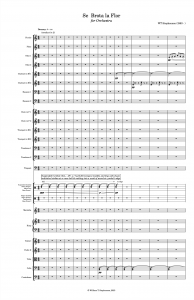
During the COVID-19 isolation, my composition teacher, Adam Schoenberg, gave me a whole new palette of sound and patiently took me through the step-by-step process of writing for Orchestra. I can honestly say that I have never enjoyed anything more in my life. However, the piece remained incomplete. At the encouragement of my current music theory & composition teacher, Esther Megargel, I pulled it out and finished it off. This is the result.
Composition Notes: This piece begins with a solo suspended cymbal roll, with winds and strings softly joining in Lydian Church Mode. It explores a specific quintal harmony (stacking a fifth on a fifth: A – E – B, a specific format of a “9th” chord) much as Aaron Copland did in the opening of Appalachian Spring. I studied that piece as I began this composition. The piece remains entirely tonal throughout. It is written in an A – B – A – B format. The second A section starts nearly identically to decrease needed practice time. Later, it explores or develops the primary rapid 8th note motive in different keys and modes. When the B section return it is only in rudimentary form as the piece devolves back into a solitary suspended cymbal roll. For anyone interested in the nerdy, music theory behind this piece or what makes it unusual, see the notes at the bottom of this page.
Synthesized MP3 File:
Page 1 of the Score is below. Please use the download button above for the full Score.
Music Theory Notes on Se Brota la Flor (2025) [for any nerds who are interested]
– Se Brota la Flor is an exploration of contrasts between sharply defined sounds vs. washes of sound
– The piece both begins and ends with a Solo suspended 18” cymbal, in both cases starting with sharply defined clicks on the dome and ending with a wash of sound at the cymbal’s edge.
– The English Horn / Winds Melody at rehearsal letter D is arranged in strict counterpoint, and so is the French Horn / Trumpet melody starting at rehearsal letter L. This gives a sharply defined, traditional sound.
– This contrasts with the transition section (starting at rehearsal letter J) where I have not attempted to follow the rules closely at all. This creates a wash of sound without distinct harmonic function — just lovely arpeggios above nearly block chords. This includes parallel 2nd motion and lots of parallel 5ths.
– I bring in a Trumpet melody (rehearsal letter M) which hopefully sounds like the walk of a drunken man or a boat tossed upon the sea.
– All of these are attempts to contrast nicely defined music against a wash of beautiful but disorganized sound.
– The piece’s A-section is written in Lydian Church mode. When the A-section returns it is essentially identical for all players which makes it easier for practice purposes. The main exception is added density, mostly in the brass.
– A 9th chord constructed with a perfect 5th above the dominant 5th and missing the 7th is a beautiful sound. I was curious to see if someone hears this dissonant chord construction frequently enough, could it eventually begin to sound consonant? You can see this clearly in measures 14-19 (F – C – G – A) and in the harp at rehearsal letter C (A – E – B – C). However, that chord structure permeates the entire piece, present in about half of the measures.
– Building a chord with a perfect 5th above the dominant 5th creates some interesting accidentals. For example, the B-section is in the key of A minor but the ii chord is played as a Bmin9: B – F# (up P5)- C# (up P5) – D (where usually you would encounter a diminished ii° chord, made more consonant by dropping the root a half step [Bb]).
– I believe the music is not technically difficult and could be played by many community orchestras. I do ask the flute, piccolo and French Horn players to play in a high, professional range.
Composer: WT Stephenson
Created: Jul 2025
Duration: 9:40
Terms of Use
I agree to notify the composer of any performance of music downloaded from this site by sending performance date and location to sleuthmusic@gmail.com.
A copy or digital picture of the program is adequate.